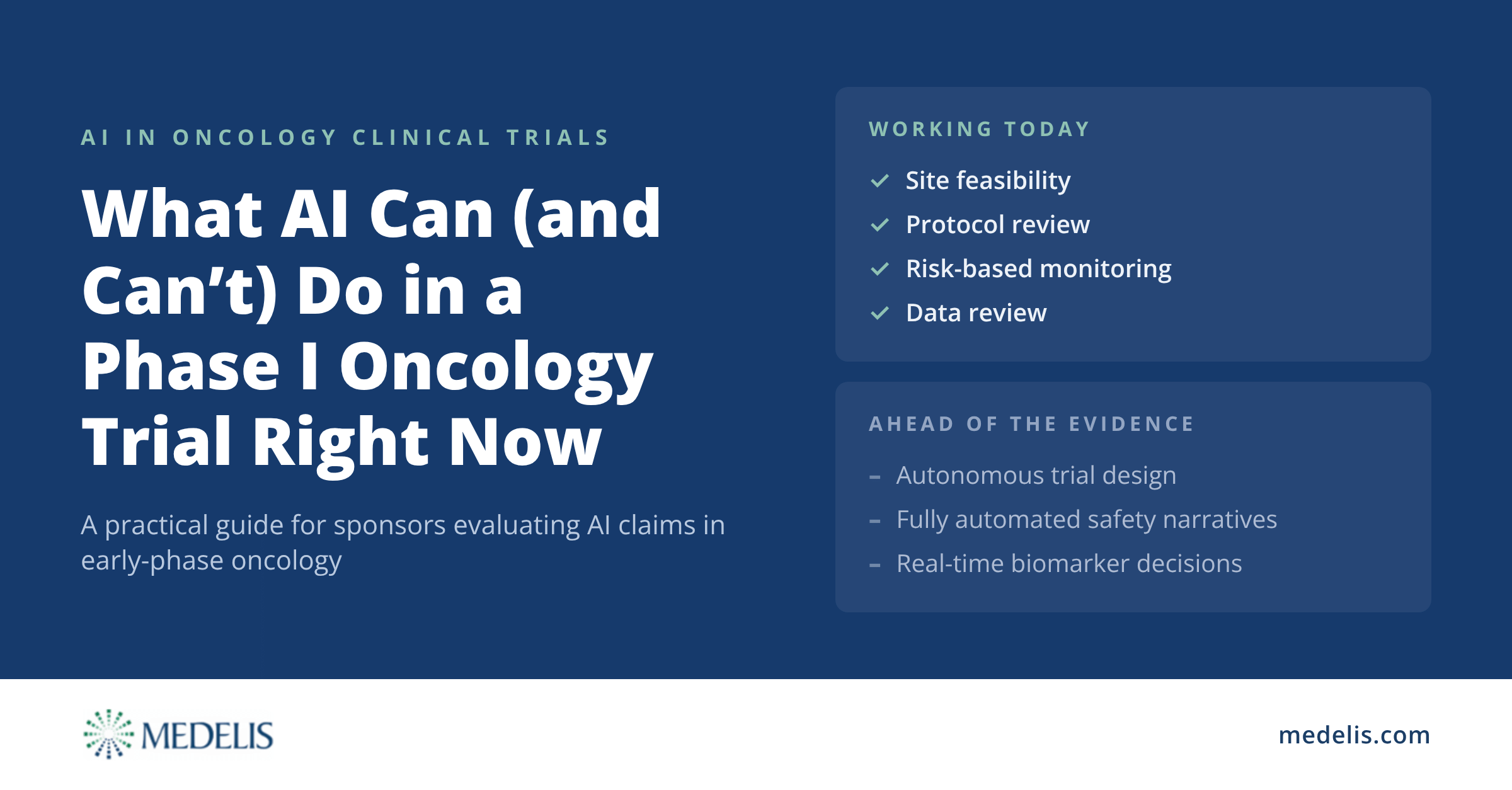



A practical guide for sponsors evaluating AI claims in early-phase oncology
By the Medelis Team · November 2026
AI comes up in nearly every conversation about clinical trial operations now. Some of what is being offered is useful. Much of it has not yet been shown to change outcomes in a real study.
For a sponsor running a Phase I oncology program, three questions matter: which uses are practical today, which are still ahead of the evidence, and what regulators expect when AI touches a decision.
This article is our view on those three questions.
Four areas of Phase I execution are where AI tools are being offered to sponsors now. In each one, the tool supports a decision that a person still makes.
Site selection has always combined data, investigator relationships, and judgment. Feasibility tools strengthen the data layer: they analyze historical enrollment, investigator experience, startup timelines, and patient population data to help rank candidate sites.
This matters in Phase I oncology because site lists are short, and one slow site can hold up a dose-escalation timeline. A data-driven ranking can flag a site that looks attractive on paper and has a pattern of slow startup or low enrollment. The investigator relationships that drive activation still do the rest.
Protocol amendments are among the more expensive disruptions in early-phase work, once site retraining, IRB resubmission, and enrollment interruption are counted. Protocol review tools compare a draft against a large body of historical protocols and flag eligibility criteria, endpoint definitions, or design choices that have tended to lead to amendments.
The tool does not write the protocol. Its value is in surfacing issues a busy team may miss in late-stage review.
Risk-based monitoring is established practice. The newer tools add pattern detection across sites, so that unusual data trends or potential deviations can be seen earlier than a scheduled review cycle would allow.
In Phase I oncology, where patient safety during dose escalation is central, seeing a signal sooner matters. What the signal means is still a monitor’s call.
Database lock is a pressure point for nearly every sponsor. Data review tools scan case report forms, lab values, and narrative fields for inconsistencies and coding issues, so that human reviewers can spend their time resolving queries rather than finding them.
For a Phase I sponsor who needs clean dose-escalation data for a board meeting or partnership discussion, a shorter query cycle is a meaningful goal. Whether a given tool delivers it is a question to ask with data in hand.
Three ideas come up often in conversations about AI in trials. In our view, none of them is ready to act on in a Phase I oncology study today.
Regulators have not delegated accountability for trial design to software. FDA’s January 2025 draft guidance on using AI to support regulatory decision-making describes a risk-based credibility assessment and places that assessment with the sponsor. The ten guiding principles for good AI practice that FDA and EMA published jointly in January 2026 take a similar line: a risk-based approach, with validation and oversight proportionate to the context of use, and performance assessment of the complete system, including how people and the AI interact.
AI can inform protocol design. Sponsors and their clinical teams remain responsible for the rationale and the decisions.
Language models can help draft narrative text. In Phase I oncology, where each serious adverse event is examined individually and dose-escalation decisions depend on careful clinical interpretation, a drafted narrative is a starting point. Medical review, attribution, and submission-quality control remain human work. We would not run a Phase I program on fully automated narratives today.
AI-assisted biomarker analysis is advancing in research settings. Translating that into prospective, real-time decision-making in a Phase I trial, where populations are small, data are sparse, and regulatory expectations are high, is not yet established. The research is promising. The routine clinical and regulatory acceptance needed to act on it in an early-phase study is not there yet.
Three documents are worth reading directly.
FDA’s draft guidance, Considerations for the Use of Artificial Intelligence To Support Regulatory Decision-Making for Drug and Biological Products (January 2025), sets out a risk-based framework for establishing the credibility of an AI model for a specific context of use. The higher the risk of the decision the model supports, the more validation and documentation FDA expects. The guidance is scoped to AI used to support regulatory decisions about safety, effectiveness, or quality. It does not cover operational uses that do not affect patient safety, drug quality, or the reliability of study results.
The joint FDA–EMA Guiding Principles of Good AI Practice in Drug Development (January 2026) set out ten principles for developing and using AI in drug development, among them a risk-based approach, a clearly defined context of use, documented data governance, performance assessment of the complete system including human–AI interaction, life-cycle management, and plain-language information for users and patients.
FDA has also shown how it handles unreviewed AI output in practice. In an April 2026 warning letter to a drug manufacturer, FDA cited the firm for using AI to create product specifications, procedures, and production records without reviewing them for accuracy and compliance, and stated that any output from an AI agent used in regulated activities “must be reviewed and cleared by an authorized human representative” of the firm’s quality unit. The letter concerns manufacturing, not clinical trials.
These apply to any CRO or technology vendor making AI claims, including us.
Our position is simple. AI belongs in bounded, human-reviewed operational work. It does not belong in medical judgment, dose-escalation decisions, or anywhere that would make accountability unclear.
That is the standard we hold any tool to, and we expect sponsors to hold us to it. Experienced oncology professionals make the decisions in a Medelis trial. The role of any technology is to give them better information sooner.
In Phase I oncology operations today, AI is doing practical work in four places:
In each case, the tool supports a decision an experienced person still makes.
If you are planning a Phase I oncology program and want to talk through how it should run, we are glad to help. Contact us at medelis.com/contact.